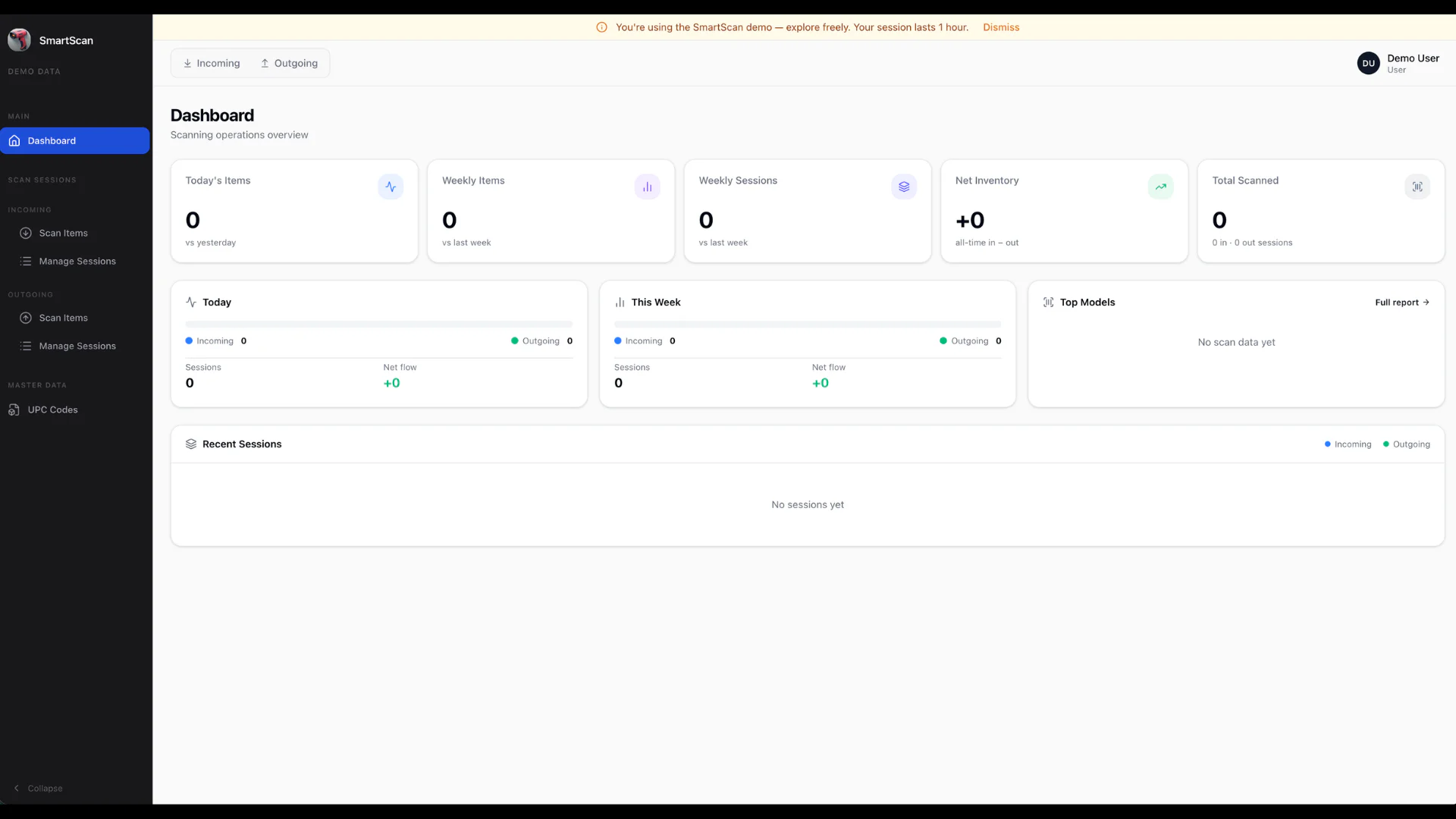

Delivery snapshot
Record date: November 15, 2025. Technology and screenshots describe the delivered version documented on this date. Any performance observations belong to the same point-in-time record. The linked live site may include later changes made by the client or other providers.Overview
Key Features
Multi-Tenant Architecture
Advanced Authentication & Session Management
Incoming & Outgoing Session Tracking
Professional PDF Generation
Granular Role-Based Access Control
UPC Catalog Management
Real-Time Dashboard & Metrics
Dark Mode & Responsive Design
Technologies Used
Frontend Stack
- Next.js 15.3.4 – App Router with React Server Components for optimal performance
- React 19 – Latest React with concurrent features and improved hydration
- TypeScript 5 – Full type safety across client and server boundaries
- Tailwind CSS 3.4.17 – Utility-first styling with custom design system
- next-themes 0.4.6 – Seamless dark/light mode implementation
- Lucide React – Modern icon library for consistent UI elements
Backend & Database
- Next.js API Routes – Type-safe server endpoints with proper error handling
- PostgreSQL – Production-grade relational database with ACID compliance
- Prisma ORM 6.10.1 – Type-safe database client with migration management
- NextAuth.js 4.24.11 – JWT-based authentication with custom session handling
Security & Authentication
- bcryptjs – Password hashing with salt rounds for secure credential storage
- JWT Strategy – Stateless authentication with automatic token refresh
- Session Revocation – Real-time session invalidation for deactivated users/tenants
- RBAC Implementation – Row-level security with tenant-scoped data access
Document Generation
- jsPDF 3.0.1 – Client-side PDF generation with custom layouts
- jspdf-autotable 5.0.2 – Table formatting for session reports
Additional Tools
- SWR 2.3.6 – React hooks for data fetching with caching
- nodemailer 6.10.1 – Email notifications for system alerts
Architecture Highlights
Multi-Tenant Data Isolation
Session Security Model
Single-Session Enforcement
PDF Branding Strategy
Type-Safe API Design
Challenges and Solutions
Multi-Tenant Complexity
Solution: Implemented Prisma-level tenant scoping with composite unique constraints (tenantId + identifier) and database indexes optimized for tenant-filtered queries. Added middleware to automatically inject tenant context into all database operations.
Session Revocation Architecture
Solution: Built custom session management layer on top of NextAuth with database-backed session tracking. JWT callbacks check revocation status on every request, with distinct logout messages for different deactivation reasons (user inactive, tenant inactive, concurrent login).
PDF Generation Performance
Solution: Implemented client-side PDF generation with jsPDF, allowing asynchronous processing with progress indicators. Optimized table rendering for sessions with 1000+ scanned items using chunked processing.
Type Safety Across Boundaries
Solution: Leveraged Prisma's generated types with custom TypeScript interfaces for API responses. Created shared type definitions for NextAuth session extensions, ensuring compile-time safety for role checks and tenant context.
Tenant Metrics Aggregation
Solution: Used Promise.all() to parallelize metric queries per tenant (user counts, session totals, item aggregates) with Prisma's efficient aggregation functions. Implemented caching layer for dashboard metrics with 5-minute refresh intervals.
Technical Highlights
Advanced Authentication Flow
- JWT-based authentication with automatic token refresh on every request
- Session revocation checks integrated into JWT callbacks for real-time enforcement
- Custom session storage layer tracking device info and revocation reasons
- Forced logout with contextual messages (tenant deactivated, user deactivated, concurrent login)
Database Design Excellence
- Composite unique constraints ensuring tenant-scoped uniqueness (e.g., tenantId + upcCode)
- Optimized indexes for frequently filtered queries (tenant scoping, session status, date ranges)
- Prisma migrations with zero-downtime deployment strategy
- Cascade deletion rules maintaining referential integrity across tenant removal
Role-Based UI Rendering
- Conditional component rendering based on role/permissions at compile time
- System administrators see tenant management panel with aggregated metrics
- Regular users access tenant-scoped workflows (scanning, session management, UPC catalog)
- Managers/admins unlock user management with tenant-aware operations
PDF Export System
- Custom layout engine for session reports with grouped item tables
- 4x6 thermal label format for box labels with QR code support potential
- Page numbering, timestamps, and subtle footer branding on all exports
- Progress indicators for large PDF generation (1000+ items)
Real-Time Updates
- SWR-powered data fetching with optimistic UI updates
- Automatic revalidation on focus/reconnection for session lists
- Live session statistics updating during scan operations
- Debounced search/filter inputs preventing excessive API calls
Impact & Results
Key Achievements
Successfully supporting multiple organizations with complete data isolation, automated session revocation, and centralized system administration. Each tenant operates independently with custom user roles and UPC catalogs. Session Integrity
Zero data loss with enforced single-session policy for regular users. Session revocation happens instantly when users/tenants are deactivated, with descriptive logout messages guiding users to administrators. Export Excellence
Professional PDF generation for all session types with consistent branding. 4x6 labels integrate seamlessly with existing shipping workflows, while full session reports provide audit-ready documentation. Type Safety & Reliability
End-to-end TypeScript coverage catches bugs at compile time. Prisma-generated types ensure database schema changes propagate safely through all application layers. Developer Experience
Clean separation of concerns with API routes handling business logic, React Server Components optimizing initial loads, and client components managing interactivity. Hot reload during development with instant feedback loops.